Micro-Vertical Pages for NetSuite Partners: How to Write a “NetSuite for [Industry]” Page
How to write a "NetSuite for [industry]" page that buyers believe: six parts, from a 2026 project rewriting industry pages for a NetSuite partner.
 Zees ZeeshanFounder, IgnitX8 min read
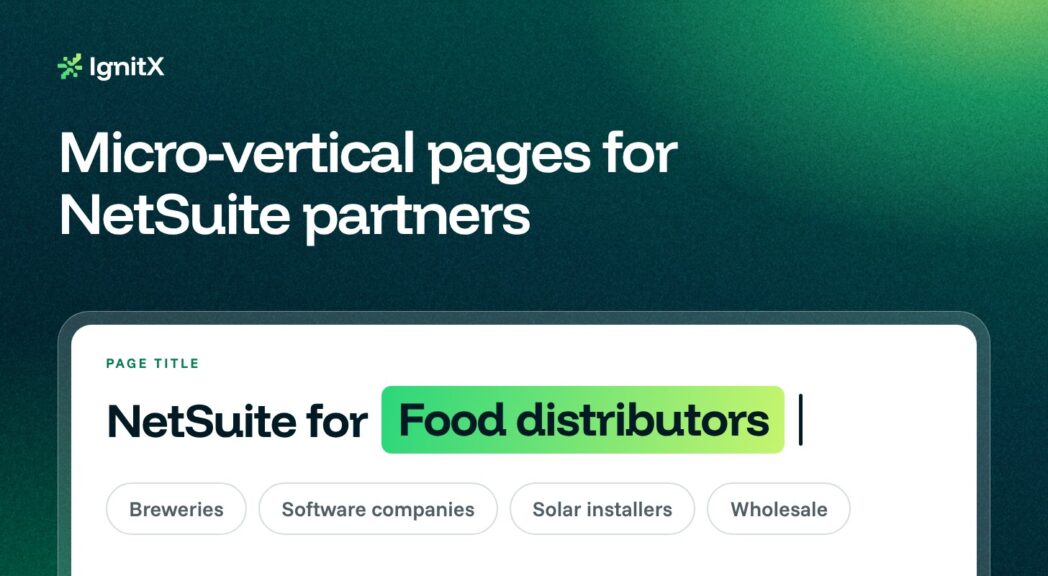
A NetSuite partner’s industry page works when a buyer from that industry can tell, on the first screen, that you have done this before, on NetSuite, for a company like theirs. This post covers the six parts I put on every such page, with what I learned on a project to rewrite eight of them for a NetSuite Solution Provider in 2026.
The short answer
| Part of the page | What goes there | What it replaces |
|---|---|---|
| 1. Title and main heading | The phrase the buyer types: “NetSuite for [industry]” | “ERP solutions for [industry]” |
| 2. Opening | The industry’s problem, in its own words | A paragraph about your firm |
| 3. What they would run | The NetSuite modules this industry buys, each with one line on why | NetSuite’s feature list, pasted |
| 4. What it connects to | The named systems you have integrated for this industry | “Seamless integration with your existing systems” |
| 5. Proof | A case study from that industry, or one labelled as coming from elsewhere | Logos from other industries, unexplained |
| 6. Numbers | Figures you can trace to a source document | Figures carried over from the old site |
Where this comes from
Since September 2026 I have been rewriting the industry pages of a NetSuite Solution Provider. Eight pages are in scope. I build them one at a time, and three were drafted by early November.
I have also reviewed industry pages that general agencies wrote for partners. The six parts above are what I do on my own pages and what I look for on theirs.
I run IgnitX and I sell this work, so weigh what follows with that in mind. No firm is named here, and the worked example near the end is made up.
Why these pages matter
An ERP buyer checks a few things about a partner before making contact. The first is whether you work with companies like theirs, with their industry and their size named. A general services page cannot answer that. An industry page can.
NetSuite has pushed partners the same way for years. It has said that partners who target micro-verticals grow five times faster than partners who do not, and its Build Your Own Microvertical program covers more than 40 niches, down to breweries and solar installers (ChannelE2E). That growth figure is NetSuite’s own and the article is not dated, so I use it as a sign of direction and nothing more.
Search shows the same thing in a plainer way. A search for “NetSuite for food and beverage distributors” on 25 November 2026 put NetSuite’s own industry pages first. The partners that followed each had a page or a guide written for that one industry. There was not a single general “industries we serve” page among them.
The common mistake: the name-swap page
The industry pages I have reviewed from general agencies were well written and told the buyer very little. My note on the last set was that the copy was generic and not written for the NetSuite market.
You can test your own page in a minute. Replace the industry name with a different one and read it again. If nothing sounds wrong, you have a services page with an industry in the title.
There is a search risk too. Google’s spam policies describe doorway abuse as near-duplicate pages built to rank for similar searches, and scaled content abuse as many pages made mainly to rank and adding little for the reader (Google Search Central, updated 23 November 2026). I cannot tell you Google will penalise a site for ten thin industry pages. Ten pages that differ by one word are still the pattern those policies describe.
The six parts, one by one
1. Put the buyer’s phrase in the title
The first rule I set on the Solution Provider project was about wording. Every industry page is written around “NetSuite for [industry]”, and none around “ERP for [industry]”.
My reasoning is this. Someone who types “ERP for” their industry is still choosing a product, and the vendors will win that search. Someone who types “NetSuite for” their industry has picked the product and is working out who can deliver it. That second person is a partner’s buyer.
2. Open with their problem, in their words
When I rewrite a block of agency copy, I follow one rule: product names out of the sentence, outcomes in. Here is the kind of change I mean. Both lines are my own examples.
- Before: “Leverage NetSuite Advanced Inventory to optimise stock levels.”
- After: “See which lots expire this month while there is still time to sell them.”
The second line could only be written for a business that holds dated stock. That is what makes it an industry page.
3. Then name what they would run
The outcome rule has a limit. A buyer comparing partners also wants to check fit, so lower on the page I name the NetSuite modules this industry buys.
I keep the list short and give each module one line on why it matters to this industry. Pasting NetSuite’s full feature list here puts you back on the name-swap page.
4. Name the systems it connects to
Each industry page on that project lists the third-party systems the industry runs next to NetSuite. I had the firm confirm that its team builds each one.
A named system tells the buyer you have seen their setup before. A promise of “seamless integration” tells them nothing they can check.
5. Show proof from that industry, and label what is borrowed
The firm had 14 case studies and every one was a PDF. We chose six to turn into pages, picked so that each industry had at least one.
Some industry pages still had to show a client from a different industry. On those I changed the section heading so it does not claim the client belongs to the industry on the page. A buyer from that industry would notice the mismatch, and then doubt the rest of the page.
6. Trace every number
The old site carried figures such as project counts and client counts. I did not take them from the old site. Each one was checked against the firm’s own source documents and case studies.
If you cannot trace a number to a document, take it off the page.
Which industries get a page, and what to call them
Start with the industries where you have proof. A page with a real client on it is easier to write and easier to believe.
Then check the name. One of the firm’s pages was aimed at “SaaS”. I retargeted it to “NetSuite for software companies” and “NetSuite for technology”. The label your team uses inside the firm can differ from the one a buyer types, so look the phrase up in your keyword tool before you name the page.
How narrow should you go? NetSuite’s own list runs to niches as small as breweries. Go as narrow as your proof allows and no further. A page for craft breweries with no brewery client on it is weaker than a page for food and beverage with two.
Building them: three practical decisions
Keep the address. Where an industry page already existed, the new content went onto the same address. We did not create new ones. Whatever the old page has earned in Google stays with it.
Build one, then the next. I wrote the first page in full, then reused its layout for the second and wrote new content for every block. Reusing the layout is fine. Reusing the sentences is how you end up with name-swap pages.
Budget the time. Writing one page takes me three to four hours. That does not include design or building it in the site.
An example outline
This is a made-up page for a partner with food and beverage distribution clients. It shows the six parts in order. Every detail in a real page has to come from your own projects.
- Title and main heading: NetSuite for Food and Beverage Distributors.
- Opening: two or three sentences on short-dated stock, recalls and customer-specific pricing, in the words a distributor’s operations lead would use.
- What you would run: the handful of NetSuite modules you implement for these clients, for example lot tracking with expiry dates, each with one line on what it fixes.
- What it connects to: the EDI provider, warehouse partner or web store you have integrated before, by name.
- Proof: one case study from a food distributor. If your nearest client is a food manufacturer, say so in the heading.
- Numbers: only figures you can point to in that case study.
When not to build one
- You have no project in that industry and nobody on the team who has worked in it. Without proof the page cannot get past part 5.
- You plan to launch ten at once. Build the one with the strongest proof first and see what it does.
- Nobody at the firm has time to confirm the integrations and the numbers. Wait until they do, because those two parts are what a buyer checks.
If you want to know which of your industries is worth a page first, our free visibility audit looks at where your firm shows up today and where it does not.
Sources
- ChannelE2E, Oracle NetSuite Expands Partner Programs to Build Micro-Vertical Markets. The five-times growth claim is NetSuite’s own. The article carries no date.
- Google Search Central, Spam policies for Google web search, updated 23 November 2026. Doorway abuse and scaled content abuse.
- A search for “NetSuite for food and beverage distributors”, run on 25 November 2026.